
Fayetteville Directory Shelves
Fayetteville city directories survive as a long but uneven set rather than one seamless database. The Washington County Historical Society research guide identifies publishers and runs, while the Fayetteville Public Library and Shiloh Museum provide the main reading points. The Grace Keith Genealogy Collection at the library is the broad local hub. Shiloh confirms selected volumes that can help when a year is absent from another catalog.
| Collection | Years | Where Held | Access |
|---|---|---|---|
| Stewart & Weeks and early Polk | 1904, with Stewart & Weeks published in 1903 | FPL reference and genealogy holdings | Ask staff for the volume |
| C.D. Shumaker | 1920-1921 | Local research collections | Catalog and desk request |
| Interstate Directory Co. | 1927-1928 through 1935-1936, various years | FPL and selected Shiloh Museum holdings | In-person volume access |
| R.L. Polk Fayetteville editions | 1939, 1947, and 1951-1996 | FPL; selected volumes at Shiloh | Reference-room access |
| Regional Polk editions | 1998-2022 | Fayetteville-Springdale-Rogers series | Confirm each year in the catalog |
| Telephone and UA student directories | Selected phone books 1939-1982; student volumes 1957-1969 | Shiloh Museum | Collection consultation |
The 1892-1893 Polk Arkansas Gazetteer adds Washington County towns before the main Fayetteville directory sequence. Gaps should be stated as gaps. A missing catalog year does not prove that publication stopped, and a listed run does not promise that every annual volume survives.
Grace Keith's Fayetteville Archive
The Grace Keith Genealogy Collection holds more than 14,000 print resources, plus microfilm, microfiche, maps, and digital images. Its breadth matters because a city directory entry is often just the first clue. Census film, county land and marriage indexes, cemetery sources, surname files, school annuals, and local papers can test that clue without sending a researcher to a new institution.
The Genealogy Desk is available at 479-856-7253 and genealogy@faylib.org. Collection hours are Monday through Thursday from 9 a.m. to 8 p.m., Friday and Saturday from 9 a.m. to 5 p.m., and Sunday from 1 p.m. to 5 p.m. Public readers, scanners, and computers support in-room work. A staff research-request service is also available, with some costs noted by the library.
The library's digital genealogy resources show how county land, marriage, newspaper, census, and subscription databases meet on one research path.

The captured library screen points to online starting places, while some tools and the obituary database still require library access.
Grace Keith began the genealogy collection in 1977 after retiring as library director. It received her name in 1985, expanded into an annex in 1992, and moved into Blair Library in 2004. Those steps explain why one room now joins the city directory shelf with unusually deep Washington County sources.
Note: Bring a year range, exact name spellings, and known addresses so library staff can route a focused request.
Fayetteville Directory Publishing Timeline
Publisher changes shape the way a Fayetteville directory should be read. Front matter, symbols, canvassing rules, and geographic scope may change even when two volumes sit side by side. Photograph the title page and key before copying names. That small step prevents a Polk symbol from being assigned the meaning used by Interstate or another publisher.
| Year or span | Directory milestone |
|---|---|
| 1892-1893 | Polk Arkansas Gazetteer includes Washington County towns. |
| 1903-1904 | Stewart & Weeks publishes the 1904 directory; Polk also has a 1904 edition. |
| 1920-1921 | C.D. Shumaker issues a Fayetteville directory. |
| 1927-1936 | Interstate Directory Co. appears across several two-year runs. |
| 1939-1996 | Polk editions form the strongest later Fayetteville sequence. |
| 1998-2022 | Regional Polk books combine Fayetteville with nearby Northwest Arkansas cities. |
Regional scope can produce name matches outside Fayetteville. Record the city heading and page context, not just the clipped entry. A 1998 or later hit may belong to Springdale, Rogers, Siloam Springs, or another covered place.
Reading Fayetteville City Directory Entries
A Fayetteville city directory entry compresses several facts into one line. Most begin with surname and given name or initials. A spouse may appear in parentheses. Widow notation may connect a death or earlier household, while occupation and employer can distinguish two residents with the same name. The residence field usually uses a short marker and street address. Exact meanings belong to that volume's abbreviation key.
| Name | Surname, given name, or initials as the publisher recorded them |
|---|---|
| Household clue | Spouse in parentheses, widow notation, or householder status |
| Work detail | Occupation, title, employer, or business address when supplied |
| Residence | Street number and name, often preceded by an abbreviated residence mark |
| Other fields | Telephone, number of children, owner marks, or firm listing in some editions |
Interstate described its coverage as residents age 18 and older, street number, mailing address, number of children, and firms. Polk included firms, private citizens, householders, and office-building occupants. Neither description makes the book a census. A canvass could miss a household, and a telephone book omits those without a listed line.
- Criss-cross directory
- A section arranged by street and house number rather than by surname.
- Householder index
- A list centered on the person associated with a household address, subject to the publisher's rules.
- Abbreviation key
- The volume's own guide to marks such as
hfor house or home andrfor resides or rooms.
Reverse Fayetteville Directory Searching
Alphabetical and reverse sections answer different questions. The alphabetical volume locates an entry when the name is known. A reverse or criss-cross section begins with the street, then moves by house number. It can show who was listed at a known address and which names appeared nearby during that publication year.
Do not force a modern address into an old volume. Fayetteville growth, annexation, street-name changes, and house-number shifts can move the same lot under a different label. Plats, legal descriptions, parcel geometry, and Sanborn sheet indexes provide bridges. The modern address-based method belongs on the Fayetteville street directory, while the historical shelf preserves what publishers printed at the time.
Can a reverse entry prove who lived there? It proves that a publisher listed a person or subscriber at that address in that edition. Pair it with a census, deed, newspaper item, or probate file before making a stronger claim.
Fayetteville Newspapers Fill Directory Gaps
The library's newspaper sequence can explain a missing or changed directory entry. Fayetteville Weekly Democrat spans 1868-1920, with Daily Democrat from 1903-1915 and Fayetteville Democrat from 1915-1937. Northwest Arkansas Times covers 1937-2014, followed by Northwest Arkansas Democrat-Gazette from 2015 to the present. Earlier research may use Fayetteville Witness, Southwest Independent, or Arkansian runs.
Search moves, marriages, deaths, legal notices, and community ties near the directory year. Overlap between newspaper titles is useful because issue survival and text recognition differ. The in-library obituary database adds a locally indexed route. An obituary remains a lead, not a certificate, so confirm an event through the county archive, probate file, cemetery evidence, or Arkansas vital-record process.
Note: Search the same event in overlapping Fayetteville papers because one title may preserve a clearer name, date, or address.
Yearbooks Extend Fayetteville Searches
Fayetteville's university population often leaves a different trail from a long-settled household. Students may use a family mailing address elsewhere, appear briefly, or never own local property. Fayetteville High School and University of Arkansas yearbooks can reconnect a former classmate with a class year, club, team, portrait, or campus group.
The University of Arkansas Special Collections vertical files add people, organizations, buildings, and local subjects beyond a standard city directory search.
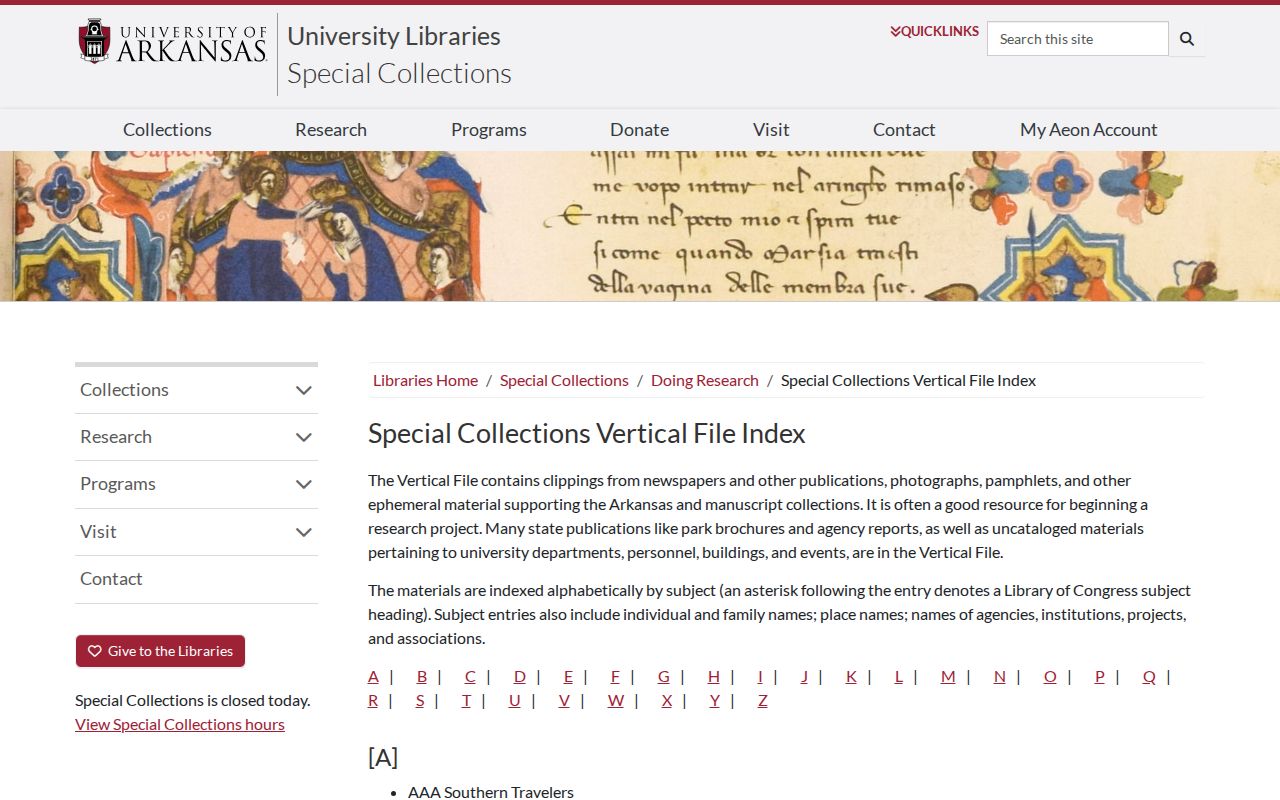
The captured index demonstrates the subject-file route, which can connect a short directory entry to campus publications, manuscripts, photographs, or institutional context.
Selected University of Arkansas student directories from 1957-1969 are held by Shiloh Museum. They supply student clues, but they do not represent the whole city. Compare the campus source with a local paper, yearbook, or later public record before merging a student with a namesake elsewhere.
Fayetteville Records Survived 1862
Washington County's early records survived an event that erased many comparable trails. Before a courthouse burned during the Civil War in 1862, officials moved the records to Fincher's Cave near Black Oak. The county credits that action with preserving its early nineteenth-century record base. Probate begins in 1830, land in 1834, court in 1835, and marriage in 1845.
That continuity does not turn every early record into an online name search. It does make a pre-Civil-War family trail plausible. The Washington County Archives holds the bridge, including its online land index for 1834-1991 and an archive counter for volume or file work. Public hours are Wednesday from 9 a.m. to 3 p.m., with a noon to 1 p.m. closure.
Trace Fayetteville Families by Directory
Family history works best when each Fayetteville city directory observation remains tied to its year and source. A disappearance can mean a move, death, marriage or name change, a missed canvass, or a publication gap. It should never be treated as proof by itself.
- Choose a target year. Photograph the title page and abbreviation key before copying the entry exactly.
- Check the prior and next available editions. Record address, spouse, occupation, employer, and every changed initial.
- Use a reverse section when available to test the address and see the nearby listings in that year.
- Pair directory years with the nearest public federal census. Fayetteville library holdings list census microfilm through 1940, and the 1950 census is public federally.
- Close the gap with deeds, local papers, probate, cemetery material, or a yearbook. Keep each source as a separate dated observation until two attributes match.
Property and deed records identify legal interests, not every occupant. Census schedules can restore household structure. Newspapers explain moves and deaths. Together, those sources turn a short directory line into a careful timeline while leaving uncertainty visible where the record stays silent.