
Fayetteville Previous Resident Sources
Different eras leave different evidence for previous residents. A current parcel card supplies the legal land key and recent deed reference. The Circuit Clerk and County Archives extend the title chain back through recorded instruments. City directories and census schedules shift the focus from owners to listed households. Permits and Sanborn maps date the building itself, while newspapers, obituaries, and probate files can close a person's trail.
| Source | Local time span | Access point | Evidence for an address |
|---|---|---|---|
| Deed indexes and books | 1834 to present, split at 1991 | Circuit Clerk and County Archives | Recorded parties, dates, and legal description |
| City and cross-reference directories | 1904 through regional volumes ending in 2022, with gaps | Fayetteville Public Library and Shiloh Museum | Listed residents or subscribers by name or address |
| Federal census | Public schedules through 1950 | FPL databases and federal archives | Household members and later street addresses |
| Civic Access permits | Likely searchable since roughly 2020 | Fayetteville Development Services | Project chronology, applicant, contractor, and attachments |
| Sanborn fire maps | 1886 through the 1930–1948 corrected set | Library of Congress, UA, and FPL | Building footprint, use, materials, and street continuity |
| Newspapers and probate | Local newspaper runs from 1841; probate from 1830 | FPL and County Archives | Moves, deaths, heirs, sales, and legal notices |
Start with the parcel regardless of the target era. It fixes the land identity before names change. For a recent question, move from the current deed into permits and later directories. For an early twentieth-century question, pair a directory with a census and Sanborn sheet. Earlier trails depend most on deeds, probate, newspapers, plats, and archive volumes.
Start Fayetteville Address History
Search the Washington County DataScout property roll by the Fayetteville street address. Save the parcel number, situs, owner name, owner mailing address, legal description, subdivision or section-township-range terms, and any deed book, page, or instrument reference. Situs means the physical parcel address. It should not be confused with the owner's mailing destination.
The card is a starting index, not a household roll. A homestead credit can support an owner-occupancy inference, but it does not list every person who lived there. An out-of-area mailing address may suggest that the owner was absent. Neither fact identifies a renter. The legal description is the durable link because it follows the land even when Fayetteville street names, numbers, directional prefixes, or parcel boundaries change.
Note: Record the parcel card's retrieval date because ownership, values, exemptions, and building facts can change.
Trace Washington County Past Owners
The Washington County records gateway joins two eras. Current indexed land and lien records cover recordings from 1992 forward. The county's Chronicle land database covers 1834 through 1991. That unusually deep bridge makes a long Fayetteville chain possible, but index entries still must be checked against the deed image or book.
- Use the parcel card's current owner and deed reference. Confirm that the purchase deed carries the same legal description.
- Record the grantor, grantee, recording date, instrument or book and page, and exact land description from the deed.
- Search the seller as a grantee in an earlier period. Match the land, not just the surname.
- Repeat through the current portal. When the chain reaches 1991, switch to Chronicle and search spelling variants, initials, book, page, and grantor or grantee role.
- Request the original book or image from Archives when the convenience index is unclear or incomplete.
- Grantor
- The party conveying or placing an interest in the land.
- Grantee
- The party receiving the interest, or a lender or beneficiary for some instrument types.
- Chain of title
- The linked sequence of recorded transfers for the same land.
- Legal description
- The lot, block, subdivision, metes-and-bounds, or section terms that identify land more reliably than an old street number.
A deed proves a recorded interest and transfer language. It may name spouses, trustees, lenders, preparers, or entities who never occupied the property. Previous residents require a second household source.
Fayetteville's 1991 Records Bridge
Washington County's early land trail survived a major break that destroyed many other local records. Before the courthouse burned in 1862, officials moved county books to Fincher's Cave near Black Oak. The official courthouse history credits that act with preserving the early nineteenth-century record base. Land books begin in 1834, while probate starts in 1830 and court material in 1835.
Online convenience ends where volume research begins. Chronicle searches Document Type, Full Search, book, page, grantor or grantee role, last name, and first name. The original handwritten indexes remain at Washington County Archives, 4 S. College Ave. Public hours are Wednesday from 9 a.m. to 3 p.m., with a noon-to-1 closure. Staff can be reached at 479-444-1543. Current records remain with the Circuit Clerk at the courthouse, open weekdays from 8 a.m. to 4:30 p.m., with phone help at 479-444-1538.
This split is central to a previous residents search. Carry the last verified book, page, party role, and legal description across the 1991 line. A loose name search risks jumping to another Fayetteville parcel.
Date a Fayetteville House
Ownership and occupancy mean little if the present building did not yet exist. Library of Congress Sanborn maps show footprints, use, construction material, doors, windows, roof form, street width, and fire context. Fayetteville editions run from 1886, 1892, 1897, 1904, 1908, 1913, 1919, and 1930, with a corrected 1930–1948 set of 27 sheets that includes Fayette Junction.
Compare the modern parcel and plat with the sheet index and nearby landmarks. Never force a present house number onto an old map. A footprint appearing between two editions can narrow construction time, while a change in use may explain why a directory switches from a household to a business listing. Sanborn maps do not name every resident.
The Fayetteville Civic Access trail covers recent work. Search an exact suggested address, keep Exact Phrase selected, choose a record type, and inspect the blue record detail plus Attachments. Permits, plans, inspections, and occupancy certificates since roughly 2020 may appear. Development Services is the phone and records fallback when older or unapproved material is missing online.
Bridge Old Fayetteville Addresses
Fayetteville growth and annexation can break a literal address search. A road may gain a directional prefix, a house number may change, or rural-edge land may shift from section-township-range wording into a subdivision lot and block. Postal Fayetteville also extends beyond city limits, so the same mailing label does not prove that an older record belonged to the municipality.
Resolve the gap with stable geography. Compare the modern parcel shape to the plat. Carry the legal description into deeds. Use a Sanborn sheet index and adjacent landmarks for an older built-up block. Then test both old and new street forms in a directory and newspaper search. Fayetteville GIS can issue an address-verification letter through the E-911 address process, and My Fayetteville Services establishes current city-limit status.
A research worksheet should preserve facts, not blend them. Record the exact name, role, date, parcel, legal description, book and page, street wording, and source. “J. Smith, grantor” and “John Smith, directory householder” remain separate observations until other facts connect them. That care matters in a county-seat and university city where names recur and some residents appear only briefly.
Close Fayetteville Resident Trails
Obituaries and probate can explain why a person vanishes from an address. Fayetteville Public Library's in-library obituary database and long newspaper runs supply death notices, family links, moves, sales, and legal notices. Probate books begin in 1837 and files in 1865 at County Archives, with later cases available through the Circuit Clerk and Search ARCourts. Match names to dates, roles, and the known address before treating an heir or fiduciary as part of the household.
Certified vital records remain controlled by Arkansas law. When an eligible order has already been placed, the Arkansas vital-record order status service accepts the confirmation number:
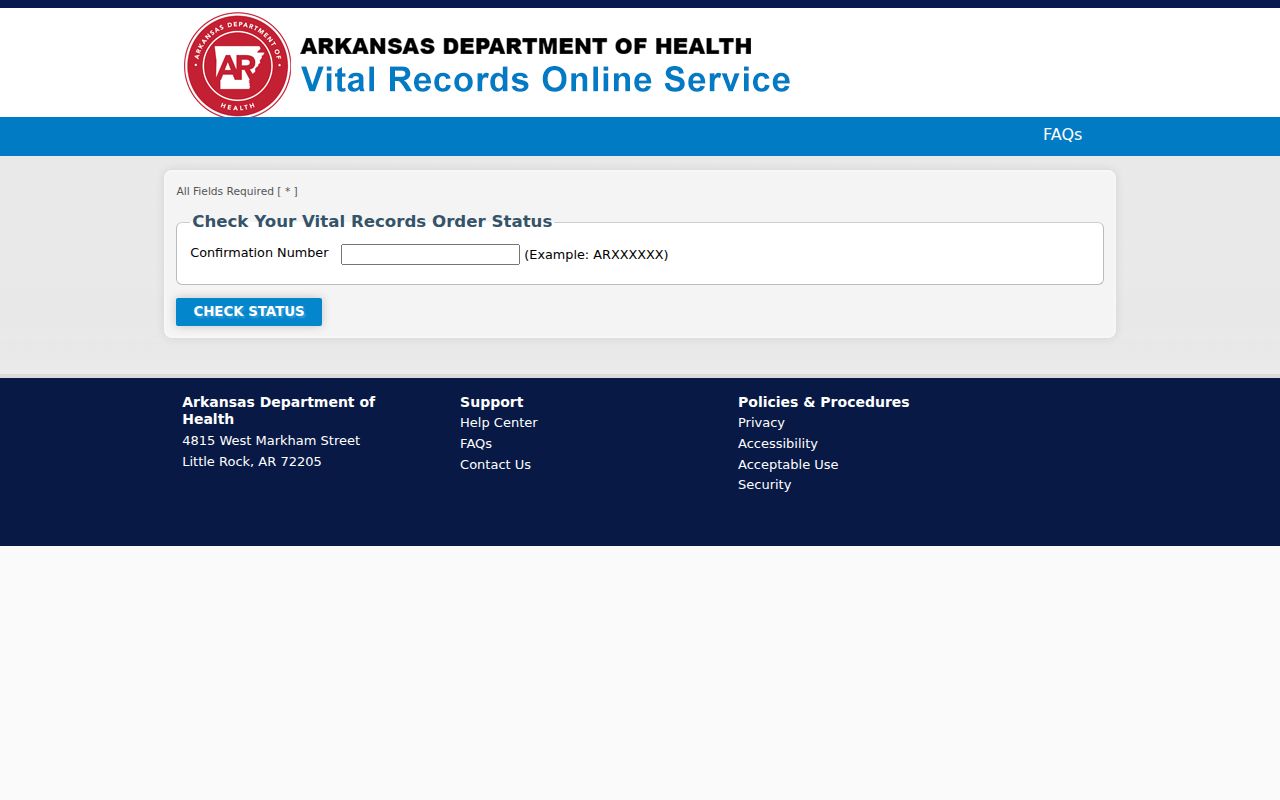
The screen tracks an order; it is not a public name index. For genealogy, births open after 100 years and deaths, marriages, and divorces after 50 years under Arkansas rules when enough identifying facts and the normal fee are supplied. Earlier Fayetteville work often starts with library and archive indexes before any certificate order.
Match Fayetteville Past Households
Directories and census schedules supply the household layer that deeds cannot. Fayetteville directory runs include editions from 1904, 1920–1921, several Interstate volumes from 1927–1928 through 1935–1936, Polk editions from 1939 and 1947 through 1996, and regional Polk volumes through 2022. A reverse or cross-reference volume arranges entries by street and house number. An alphabetical volume starts with a person's name. The collections and publishers are detailed on the Fayetteville city directory page.
- Choose a directory year near the deed transfer and copy the entry exactly, including spouse, occupation, address, and abbreviations.
- Check the volume before and after it. A gap may mean a move, death, name change, missed canvass, or publication gap.
- Pair the directory with the nearest public census through 1950. Compare household members, age, work, birthplace, and street information.
- Add a dated newspaper, yearbook, probate, permit, or cemetery source. Keep each observation separate until two identifiers agree.
Telephone directories omit households without a listed line. City directories may omit people missed by canvass. Census entries can contain spelling and reporting errors. Previous residents are best supported when two independent sources agree on the same person, address, and period.
Lawful use. Research previous residents for Fayetteville house history, genealogy, heirs, or personal curiosity. Never use a historical trail to track, harass, threaten, or harm a living person.